Bigfoot News – September 2019

This is something new that we’re trying here at OregonBigfoot.com this month, September 2019.

It takes a lot of time to take “news items” and offer them up here with workinglinks and programming. But we want to keep you informed. News items will be mixed in with updates to the Members’ and public site of Oregonbigfoot.com. This is how the blog will move forward for now.

Your comments are welcome but will also be moderated. Thank you.


Bigfoot is making news for a bridge closure:


Why is the bridge closed? Some blame Bigfoot  – FOX CHICAGO 13

Some blame Bigfoot … the Waits River was not due to the “displacement of or intrusion on a `Sasquatch‘ or Bigfoot, either a single creature or several.

Flyer denies Bigfoot is behind closure of Vermont bridge … “displacement of or intrusion on a ‘Sasquatch‘ or Bigfoot, either a single creature or several…


Texas school teaching students life skills in ‘Adulting 101’

… said the prolonged closure of the Creamery Bridge over the Waits River was not due to the “displacement of or intrusion on a ‘Sasquatch‘ or Bigfoot, …

Psychology in Bigfooting – BOUNDARIES

Ironic that this would be the subject for my final blog.

For over two years now, I have been battling impending cervical cancer without health insurance while raising my daughter with very little financial support for her other than what I provide. Medical bills for tests, labs, procedures and checkups have been daunting and so has the fear of not knowing what’s next. For a while there, things were going better. However, last week, I received test results from a checkup that were less than encouraging.

My doctor has insisted that I remove as much stress as possible from my life in order to fight this. Being available and visible to the public makes one vulnerable to all sorts of craziness and the vast majority of stress in my life over the last couple of years has been due to that. More so, even, than this illness.

It ends here. For my sake, and for my daughter’s sake. I have a child to care for and she is my top priority. I need to be healthy in order to do so and that demands that I have peace in my life.

The Oregon Bigfoot public website will remain online for now. I will no longer be publishing the blog. My facebook account will be closed down to all but my closest friends and family. The Oregon Bigfoot members’ community WILL REMAIN ONLINE but ONLY members of the OB community will be able to contact me from now on. The OB members’ community will still be in existence for the co-education and support of witnesses.

My email address, if you have it, will still be functional. However, I will not be corresponding with anyone other than close friends, family and OB members.

I want to thank all of you who have been supportive over the years. If you’re so inclined, please say a prayer or send some positive thoughts this direction. It would be greatly appreciated.

The following blog was written a little over a week ago. It is not finished, nor will it be, but it’s all I have left to offer.  I hope, in it, you find something helpful.

Thank you for reading and I wish you the very best.

(2018 update: For those  who’ve made snarky comments online about my “impending” cervical cancer diagnosis and “how can cancer be impending?”…Let’s set the record straight.

“Impending cervical cancer” were the exact words of my doctor when I was diagnosed with ASCUS cells, yet again. We had been in  “watch and wait” mode for months. She checked me again a month later. And it had staged quickly to full-blown STAGE 2 CANCER in less than a month between visits, necessitating an immediate and painful procedure paid out-of-pocket with no insurance. Hence the post.

I would go into even more detail, but I’d rather not.

Please educate yourself before you start spewing anonymous judgments online. It was scary as hell and it “impended” into real-live cancer FAST between tests. I was worried about being able to stay alive to take care of my kid.

The next time someone shares limited personal medical information in an attempt to explain why they need to concentrate on self-care because of a terrifying diagnosis, please try to be kind, or at least “nice” or neutral or even non-judgmental, if kindness or empathy fails you. Your anonymous judgments don’t define my “credibility” at all, but they speak volumes about your lack of compassion.

For those of you who sent well-wishes and are still friends to this day, thank you! Your support meant the world to me and still does. I am currently cancer-free, but at continued risk of a relapse and therefore I still need to try to maintain a low-stress lifestyle.

This is why I no longer wish to be a public figure. Asshats like those mentioned above are more than anyone needs to deal with.)


**********************************

This is part three in a blog series. If you haven’t read part one (Psychology in bigfooting – FEAR) or part two (Psychology in Bigfooting – CONTROL) yet, please do.

Today’s topic is boundaries.

In the last two posts, we examined how fear is the root of dysfunctional behavior in human relationships and how people attempt to control one another when they feel fear. Today, we will discuss how establishing boundaries for oneself can mitigate the role of dysfunction in our lives.

Having clear-cut boundaries established within ourselves, and respecting the boundaries of others, is part of having a highly developed EQ (Emotional Quotient). Boundaries allow us to determine how we will and will not allow people in our lives to treat us. They establish our sense of Self, protect us from the whims, problems, needs and concerns of dysfunctional people, help us maintain autonomy and give us a sense of peace. Let’s look at each of those things more closely:

#1 Boundaries allow us to determine how we will and will not allow people in our lives to treat us. When we have established boundaries, we do not allow people to intimidate us or manipulate us.  We have a clear, healthy sense of how we wish to be treated and we maintain relationships only with those individuals who respect that.

#2 Boundaries establish our sense of Self: Others may have differing opinions, ideas and beliefs. We respect that, and do not feel the need to become someone we are not for another. Boundaries help to establish the difference between “me” and “you”. Your opinions are not mine. His beliefs are not yours.

#3 Boundaries protect us from the whims, problems, needs and concerns of dysfunctional people. While acting in a caring and concerned manner is one thing, rescuing people and allowing ourselves to be manipulated is another. (We’ll examine this more in a bit…)

#4 Boundaries help us maintain autonomy. When we maintain clearly established boundaries, we take responsibility for the emotions and actions that are ours, and allow others responsibility for themselves. We do not give in to unreasonable demands made by others.

#5 Boundaries give us a sense of peace. This is, perhaps, the most important function of maintaining our boundaries. With them, we know where we end and others begin. We have a clear idea of what behaviors are acceptable to us, and what is unacceptable. Without them, we fumble around in the dark in our interpersonal relationships, giving in to guilt trips, rescuing others, trying to control others, behaving dysfunctionally ourselves and wondering why our personal relationships become ugly or fail.

Boundaries light the way in the darkness of interpersonal relationships.

Maintaining our own personal boundaries is important, but so is respecting the boundaries of others. Controlling, intimidating, guilt-tripping, asking others to do for us what we can do for ourselves… these are all examples of over-stepping someone’s boundaries. Part of respecting others’ boundaries is recognizing others’ right to feel the way they do about things and not attempting to control them. You can offer insight (which is what this blog series has been about). You can share your own feelings and ideas in an attempt to inspire a different understanding in another (if you have permission from another to do so). But you cannot CONTROL others’ feelings, or make them feel something that they don’t.

When you maintain clear personal boundaries and respect the boundaries of others, it  looks something like this… I am me. You are you. I will meet you in the middle and you can meet me in the middle. I will not cross that line with you, either to control you or rescue you. I will not expect you to cross that line, nor will I allow you to. I am responsible for myself. You are responsible for yourself. If you cannot respect that, and attempt to push into my space or pull me into yours, I will remove myself from you.

Think of a personal relationship you have RIGHT NOW in which you feel drama, discord or discomfort. It can be with a spouse, a family member, a co-worker, a friend, an acquaintance, a member of the bigfoot community. Can you clearly identify WHAT the drama is? Are you angry with them? Are they angry with you?

Someone is crossing someone’s boundaries.

Is it you? Are you angry (fearful) because you cannot control that person? Or are you angry (fearful) because they have crossed a boundary that you have? Are they angry with (fearful of) you because you’re trying to control them? Or are they angry with (fearful of) you because they cannot control you? Who’s stepping over that middle line?

The reason it’s so important to have CLEARLY established boundaries is so we can figure out who’s crossing the line and take steps to remedy that and minimize the dysfunction.

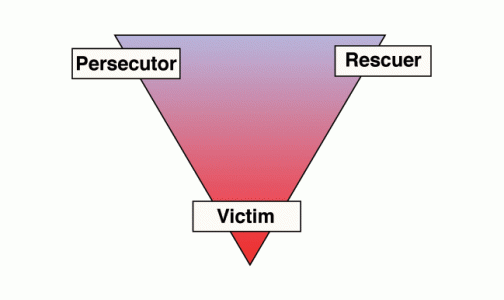
This was shared with me years ago and has turned out to be one of the most powerful interpersonal tools I’ve ever learned. The Karpman Drama Triangle is a model of dysfunctional interaction (overstepping boundaries) and it unwittingly affects every relationship we enter into unless we’re aware of it and take steps to minimize its effects. It was visualized to me as a board game.

There are three positions on the board. Victim, Perpetrator and Rescuer. The game begins when someone “should’s” on us and attempts to make us responsible for their feelings or behavior. “You should do this,” they say. Or, “You should not have done that.” It may not be that overt. Often, it’s subtle… phrased in a way that is not direct but it’s still a guilt trip, a manipulation – someone trying to control us – and once we’ve taken the bait, the game is on. (Imagine yourself buried under a big, brown, stinky pile of someone’s “should”.)

Here’s how the game works: The first person always begins in the Victim position, in an attempt to make someone else responsible for their feelings or actions: “You should have…” Or, “You should not have…” Our gamepiece has been moved to the Perpetrator position, whether we like it or not. Do you notice that we’ve just allowed someone else control over us? They pulled us into the game and placed our gamepiece where they wanted it.

(REAL PERPETRATORS DO EXIST. THE ONLY TIME A “SHOULD” IS VALID IS WHEN SOMEONE IS GENUINELY HARMING ANOTHER OR OVERSTEPPING BOUNDARIES. NO ONE SHOULD DO THAT, NOR BE ALLOWED TO.)

Now it’s our turn to react (and here comes the continuation of the dysfunction). Here’s the first of two moves we can make. We can choose the Rescuer spot: “I’m so sorry! What can I do to make it up to you?” The trouble is, if we take the Rescuer position, we will inevitably end up in the Victim role. Why? Because in making ourselves responsible for someone’s feelings or actions when we did not truly harm them and by giving in to their unreasonable expectation that we are responsible for them, we become a victim. We have allowed them to pull us across that boundary line and now we are in their space, responsible for their feelings or actions.

Or we could knock the Victim from their spot on the board and take it for our own, while casting them into the Perpetrator position: “Well, I only did that because YOU…” We have now pulled them across our boundary line into our space, making them responsible for our feelings/actions. The dysfunction continues because we’ve now made ourselves the victim and them the perpetrator.

This dynamic plays out in our day-to-day lives on a regular basis if we are unaware of it. Think again about that someone who “made” you feel guilty when you didn’t truly harm them, or someone whom you’re angry with because they didn’t do something you felt they “should” have (even though it didn’t harm you… it was just something you wanted or preferred). What was the “should”? Who crossed whose line?  How did you react? Did you try to rescue them? Did you go on the attack and cry Victim?

“Crying victim” is not the same this as being victimized. People who don’t respect others’ boundaries ARE perpetrators. Genuine perpetrators are the ones who damage you. Who attempt to coerce you into feeling responsible for their feelings and behaviors. Who refuse to respect your boundaries. Some people never learned how to relate to others in any other way. They guilt trip. They manipulate. They don’t respect others boundaries or feelings. They interact dysfunctionally. They refuse to be responsible for their own feelings and, instead, expect others to accept responsibility for them. They ARE genuine perpetrators and the only way to not play game is to avoid them.

The ONLY “should’s” that SHOULD exist are those which genuinely protect us and others. People SHOULD not harm others. We SHOULD be able to have boundaries that protect us.

If you’re thinking of sucking someone into the drama triangle… DON’T. Be responsible for your own feelings and actions. And here’s a secret… There is an escape hatch from the drama triangle if  you have been unwittingly sucked  into it. It’s in the “False Perpetrator” position, when you’re being guilted into something or blamed for someone’s feelings or actions and you’ve done nothing to harm them. It’s carefully hidden in allowing others to be responsible for their own feelings and actions . It looks something like this:

“I’m sorry you feel that way.”

It’s that simple. Yes, it’s uncomfortable, while those who remain in the triangle continue to see us as the “Perpetrator” because they’d prefer to try to make us feel responsible for their feelings and behaviors rather than holding themselves personally accountable for them.

Our awareness of the drama triangle, and knowledge of how not to bite the hook, or to extricate ourselves from it if we’ve unwittingly stumbled inside, can make all the difference in the quality of our lives. Emotional maturity is about maintaining our personal boundaries, being responsible for our own feelings, and allowing others responsibility for theirs. If someone is overstepping your boundaries or trying to get you to be responsible for them by claiming perpetual victim-hood and pointing the finger at us as a perpetrator when we have NOT done something to truly harm them, it’s time to end the game. It’s impossible to have a healthy relationship with someone who is stuck in the triangle and refuses to accept responsibility for their own feelings and actions. Interactions with that person will always be a manipulation of one sort or another as they attempt to control our feelings and make us responsible for theirs. It’s exhausting, fruitless, dysfunctional and sometimes even dangerous.

The final part of our boundaries are the ones we hold ourselves to – internal instructions we give to ourselves about how we will and will not treat others. Those are called “Ethics“. Our ethics, and how we treat others, are the birthplace of emotional intelligence… and inner peace.


***********

NOTICE: The Oregon Bigfoot blog is copyrighted. You may not post content from this blog in whole or in part on anywhere without express written permission from the blog owner.

Psychology in bigfooting – CONTROL

This is part two in a blog series. If you haven’t read part one (Psychology in bigfooting – FEAR) yet, please do.

Today, I’d like to talk about control.

When we feel fear of any kind, the natural human reaction is to attempt to gain control of the situation. When we are in actual danger, gaining control can be a helpful response. If that semi-truck is barreling down on you, jumping out of the way is a way to regain control of your safety (fear of being run over). If you are living an unhealthy lifestyle, making better choices in what you eat or how much you exercise is a healthy response to real potential dangers (fear of negative health consequences). On 9/11, passengers on Flight 93 attempted to take control of the situation because they knew they were in danger. That was a healthy response to a real danger.

But things get sticky when we attempt to control one another due to perceived dangers in interpersonal relationships. It makes our relationships unhealthy. If a significant other is manipulating us with guilt because we  didn’t go to the company Christmas party with them, they are attempting to control our emotions and behaviors (fear of showing up alone or not having us involved in their life). If a friend has different religious or political views than we do and we get in a heated argument with them, we are trying to control their beliefs (fear of being wrong, of not being respected, or of feeling invalidated by someone whose opinion we value).

When we attempt to control others, we are not controlling ourselves.

That’s an important concept. Our ability to manage our own emotions, our own fear, leads us to a place of peace in which we don’t attempt to flex muscles we don’t have in trying to control another. Control of another is an illusion. We might be able to manipulate someone in the short term, but the “controlee” will balk eventually. The feelings of mistrust and insecurity which come as a result of allowing ourselves to be manipulated for another’s benefit manifest in subtle ways, eventually destroying the other’s hold on us. In some cases, depending upon how self-aware we are, we may never even understand what’s happened… we just somehow break free.

The bigfoot community at large – which includes researchers, witnesses and the “peanut gallery” (those who don’t do actual field research or have never been a witness but simply sit behind their keyboards and opine on what everyone else says or does) – is a perfect example of dysfunction at work. In the bigfoot community, people bicker all the time in an attempt to control one another. Public forums are rife with conflict and discord: individuals arguing about who did what to whom (trying to control public perception and reputation), about whether to kill a Sasquatch or not (trying to control other’s thoughts and actions), about whether Sasquatch is “human or ape”  or “paranormal” or “flesh and blood” (trying to control one another’s beliefs through semantic argument), threatening each other with lawsuits, public humiliation or breach of trust (manipulation through fear in order to silence another), and even threats of physical violence from time to time.

When an individual harbors perceived fear of which they are unaware or which is not managed from an internal locus of control, they will inevitably turn toward controlling and manipulating others in order to “deal” with their fear. (They’re not dealing with it. They’re coping with it. Addressing something directly is dealing with it. Coping mechanisms are indicative of dysfunction – unaddressed fear.)

What is ironic about this is that in the process of trying to manipulate others, we give our control away to them. When our locus of control is not firmly internal, it is external. We try to manipulate public perception because we care what others think of us. We try to control other’s ideas and beliefs  and actions because we fear those things. At that point, we’re not really in control, are we? Like I said, controlling others is an illusion.

The way we inherently interact with fear and our desire to control others in our personal lives also affects our interactions with the Big Guys in the field. Remember: You can’t leave your personality at home.

It may not be readily apparent, at first glance. But the truth  (the WHAT) can’t hide from the question “Why?” if you ask it enough times. To get to the underlying root or cause of an issue (the WHAT), I find asking “Why?” repeatedly is a useful tool. Let’s try it:

In the field, researchers often try to control their interactions with Sasquatch. Why? Because they go into the field with an agenda. Why? Because there is an underlying fear that causes them to have an agenda in the first place.

For instance, a researcher might really want to prove Sasquatch exists. Why? Because he’s put his ego on the line with friends, family, coworkers or peers. Here’s the what: He has a fear of being ridiculed, of being wrong. So he goes out and tries to prove that Sasquatch exists by attempting to gather evidence – perhaps at all costs. His judgment, at this point, is clouded by the desire to prove his critics wrong and himself right. His locus of control is no longer internal – his behavior is affected by the external perception of his friends, family, coworkers or peers in the community.

Here’s another scenario: A researcher may have dreams of being “the one” to solve the mystery once and for all. He wants to shoot/photograph/videotape a Sasquatch. Why? He believes that doing so would afford him status or fame. Why is that important? That question finally leads us to the what: He has a fear of being perceived as insignificant or irrelevant. His locus of control is external – public perception of him controls his actions.

Sometimes, people get upset when I say that researchers have an agenda. They feel offended, deny, minimize or justify it, or accuse me of making a “straw man” argument, as if I’m somehow passing judgment on them rather than simply stating a fact. But the very point of “research” is to study, to collect evidence. Ask any bigfoot researcher what their goal is. A research “organization” without a goal, without a game plan, is not “organized”. Another word for goal is agenda. “But I just want to know whether it exists or not!” A researcher without a goal, without an agenda, without a camera, without an evidence collection bag, isn’t a researcher. They’re a would-be witness.

I’ve been on plenty of organized bigfoot research trips. I was a researcher for 20 years. Researchers attempt to collect evidence in an attempt to prove that Sasquatch exists. It’s not that there is necessarily a nefarious intent. It’s just that there is an INTENT/GOAL/AGENDA period. Long-term witnesses usually just passively experience Sasquatch. They make themselves available to MUTUAL INTERACTION, take what they get, and don’t force the issue – unlike researchers, who are out there to achieve a goal. Therefore, researchers rarely understand when a witness says, “I know they exist. I don’t need to prove it to anyone…” because that is the opposite of their intent.

Occasionally, witnesses end up trying to control their interactions with Sasquatch, too. Here is a scenario I’ve seen several times in the 2+ decades I’ve worked with long-term witnesses: A witness comes forward, having had multiple interactions with a Sasquatch on their property. Until now, their interactions have been successful because they didn’t have an agenda… they allowed the Big Guys to remain in control. However, they naively begin posting on public bigfoot message boards about their encounters in order to share their understanding of the subject and are immediately bombarded by the peanut gallery with demands for “proof” or “evidence” that their stories are true. (The critics on the board are FEARFUL of believing the witness without proof, so they attempt to control the witness by manipulating them into gathering evidence, posting photos, etc.) The witness, feeling ridiculed, usually does one, or several, of the following:

1. The witness states, “I know they exist. I don’t need to prove it to anyone.” They continue to get bombarded until they get sick of it and leave the forum. They have maintained their internal locus of control and have not allowed themselves to be manipulated. The critics, however, will give them a place of honor in the “hall of shame” and they will be the butt of running jokes from then on. (I’ve seen this happen to many witnesses I know, unfortunately.)

2. The witness gives in to the demand and posts a photo or two. The other forum members dissect the photo, find it unworthy, and continue their demands. At this point, the witness usually responds with either #1, #3.

3. The witness goes out into the field in their habituation area and begins trying to collect evidence to silence the critics. Now that the witness has allowed their locus of control to shift outwardly to the critics, they begin to attempt to control their interactions with the Sasquatch. The critics have successfully manipulated them into having an agenda. Their behavior reflects this as they attempt to take photographs, put up camera traps, and collect evidence. Their behavior has shifted from that of a witness (a passive participant) to that of a researcher (someone with an agenda) and the habituation suffers.

4. The witness, tired of presenting evidence that is not “good enough” for the critics, begins to hoax evidence in desperation. The critics see through the hoaxes – the witness is ridiculed and dismissed entirely. Nevermind that the witness really did have ongoing interactions. They are now labeled a hoaxer and a “hoaxer” they will forever be in the minds of the critics.

Now, let’s look at #1 again.  “I know they exist. I don’t need to prove it to anyone.” There is a powerful message in that statement – and one that speaks directly to our topic of control.

Control is not the antidote to fear. Acceptance is.

When we are faced with something that frightens us that we cannot control, such as another person’s ideas, beliefs, behavior…  the healthiest thing we can do is accept that and move on. Sometimes, we can move on with that person. We can simply accept that they feel differently than we do, respect that, and continue our relationship. Sometimes we cannot. If someone is interacting with us in a controlling or unhealthy manner, we can accept that (have to, really, because we cannot control them) but we can remove ourselves from the situation if that is the healthiest decision.

Another thing that helps us to stay in control of ourselves while not controlling others – in other words, maintaining healthy relationships with ourselves and the world around us – is boundaries. We’ll talk about that in the next blog post.

As always, your comments are welcome below.

****************************

As we delve deeper into this series, I want to provide you with a few of the key concepts we’ve discussed so far and a little more information on them that you might find useful:

Fear – Fear is the primary emotion behind secondary emotions such as jealousy, anger, insecurity, intolerance, distrust, hate, arrogance.

Dysfunction – Relationship dysfunction occurs when fear is not directly addressed; rather, knee-jerk reactions or coping mechanisms come into play and we attempt to control others rather than controlling our own emotions and behaviors.

Emotional Quotient – Also known as Emotional Intelligence or EQ, this concept describes our emotional maturity. People with a high EQ take responsibility for their emotions, control themselves rather than attempting to control others, deal with disappointment, fear and anger in a healthy manner, communicate effectively, maintain healthy boundaries for themselves and respect the boundaries of others. It has nothing to do with IQ. People with a high IQ can have a low EQ and visa versa.

Locus of control – An internal locus of control comes from taking responsibility for our emotions, thoughts and behaviors (responsibility or “the ability to respond” ). When we have an internal locus of control, we are in control of and responsible for ourselves. An external locus of control leads to feelings of helplessness, blaming others, and feeling like a perpetual victim. Read more here.

Acceptance – Wikipedia describes acceptance as “a person’s assent to the reality of a situation, recognizing a process or condition (often a negative or uncomfortable situation) without attempting to change it, protest, or exit. The concept is close in meaning to ‘acquiescence’, derived from the Latin ‘acquiēscere’ (to find rest in).Acceptance allows us to find peace in situations that are beyond our control.


Psychology in bigfooting – FEAR

There is an adage that comes up regularly in bigfooting… “When you look for bigfoot, you find yourself.” The longer I pursue this subject, the more truth I find in that statement. Human psychology plays a pivotal role in our interaction with this subject. (Once again, I find myself staring at a blinking cursor, trying to figure out how to address a topic that is too complex for a single blog post. This will most likely develop into another one of those multi-part blog series.)

Today, I want to talk about fear.

Wikipedia defines fear as “ a distressing negative sensation induced by a perceived threat.” The second-to-the-last word in that sentence is key: “Perceived”. We feel fear when we are in danger. We also feel fear when we perceive that we are in danger, whether we really are or not. That is an important distinction because fear is a powerful emotion that causes us to react in real ways, whether the thing we fear is real or not.

Fear has a powerful impact on human relationships. When we interact in a healthy way with the world around us – situations we find ourselves in or people we interact with – we could say that we function well. The opposite of that is DYSFUNCTION.

FEAR IS THE ROOT OF ALL EVIL (DYSFUNCTION) IN HUMAN RELATIONSHIPS.

Fear causes humans to do terrible things. It is the reason we go to war and is the underlying source of dysfunction in interpersonal relationships. It is the cause of greed (fear of poverty), it is the reason people lie (fear of the consequences that come with honesty), it is the reason people cheat on a  spouse (fear of feeling unattractive) and the reason people try to control one another. Fear is the primary emotion behind secondary emotions such as jealousy, anger, insecurity, intolerance, distrust, hate, arrogance… if it’s a negative feeling or behavior, you’ll find fear behind it.

In case you question the truth of that statement, let’s do an exercise. Please humor me and try this:

Think of a situation that made you feel angry.

Describe the situation briefly. Perhaps someone cut you off on the freeway. Maybe a coworker didn’t invite you to a group lunch. Or you saw your significant other being a little too “friendly” with someone of the opposite sex. Maybe a friend said something behind your back. Or someone on an online forum pissed you off.

Describe the emotions you felt. Were you angry? Hurt? Jealous?

How did you react? Honestly. Did you yell? Sulk? Flip the guy off on the freeway who cut you off? Get snippy and short with your significant other? Withdraw from your coworker? Give your friend the silent treatment?

Finally, try to identify what it was you were AFRAID of. What did you FEAR in that situation? If someone cut you off on the freeway, did you feel afraid because they endangered you? If you weren’t invited to lunch, did you feel afraid that maybe you were being excluded intentionally? Did that person in the forum make you feel afraid that you looked stupid for what you said?

If you wish to share your answers or reactions in the comments section below, please do.

Everyone behaves “dysfunctionally” sometimes. In other words, everyone has knee-jerk reactions to perceived fears that perhaps don’t coincide with the actual level of danger. Our awareness of our fears and corresponding emotions, our ability to manage those successfully, and our ability to address them directly with one another using healthy interpersonal communication skills all play a part in how functional or dysfunctional we are in our dealings with ourselves and the people around us. The less aware we are of our fears and our unconscious reactions to them, the more they manifest in our lives in the form of dysfunction. Those who are the least aware of their dysfunction tend to broadcast it loudest in their interpersonal reactions and they are likely oblivious to it. That’s the key to dysfunction: it stems from fear and a lack of self-awareness. Those who are self-aware tend  to see fear and dysfunction more clearly – in both themselves and in others.

Some fear is natural, healthy and helpful. You wouldn’t stand still if a semi-truck was barreling down on you. You wouldn’t stay in a relationship with an abusive individual. You wouldn’t walk up to a snarling dog and pet it. None of those reactions are dysfunctional. They’re healthy reactions to a real threat. But awareness of fear and our ability to determine which fears we have are REAL and which ones are simply PERCEIVED allows us to keep ourselves safe from real danger and minimize our dysfunctional reactions to “threats” which are only perceived.

In the bigfoot community, especially on online forums, I see truckloads of dysfunction  –  perceived fear manifesting in ugly reactions. Arrogance, sarcasm, sniping, backbiting, ridicule, threats, shaming, bruised egos, arrogance, arrogance… did I mention arrogance? ;)… Personalities posturing for a position of relevance, feeling threatened by something someone said, cutting down another’s contributions, in-fighting, arguing publicly and attempting to shame one another in front of peers, disregarding the feelings of witnesses or ridiculing them while wanting their “best” evidence, getting angry over perceived slights… Fear of someone else being right, fear of someone else being more popular,  fear of being irrelevant,  fear of others “damaging the credibility of the field” (in other words, “making me look like an ass…”), fear of being attacked (so people go on the offensive and attack first), fear of someone else being “first” or “better”, fear of being excluded, fear that someone else might actually be the one to solve the mystery or that it might never be solved at all…

Fear directs many interactions in the bigfoot community, because fear directs many things in our lives when we’re unaware of it… and many people are. I want to say that again because it’s important: People, for the most part, live unconsciously in fear. Our interactions with others in the bigfoot community are natural reflection of how we, as individuals, interact with fear in our personal lives. And it is exacerbated online. The internet is a sadly dehumanizing force in our lives; the people on the other end of the line are less real somehow. The whisper of our dysfunction is magnified to a deafening roar when we remove the accountability that goes with face-to-face interaction and hide behind keyboards and computer screens, nursing our fears, holding our grudges, licking the wounds of our damaged egos and gearing up for the next assault on that faceless username which threatened and frightened us.

Some react by bombarding others with intellect, not realizing that  IQ doesn’t make a bit of difference, because the EQ (emotional quotient or emotional intelligence level) is the same. Those with expansive vocabularies smite their enemies with wordy, gleeful arrogance, but their reactions are no less dysfunctional than the guy who can’t spell worth a crap and resorts to name-calling or threats of physical violence. It’s all a reaction to fear.

So what does this have to do with bigfoot?

Just as we bring our personal fears and dysfunctions into play when we interact with others in the bigfoot community, we also bring them into our relationship with the subject… and the Sasquatches themselves, if we are out in the field. You can’t leave your personality at home. I’ve personally known witnesses who feared continuing ridicule and began changing their interactions within their habituation as a result in order to attempt to gather “proof” – to the detriment of the habituation and the relationship they had carefully cultivated. I’ve known researchers to commit egregious acts toward Sasquatches in an attempt to prove that they are “right” and that Sasquatch does, in fact, exist. It’s all based in fear.

Fear is the root of dysfunctional behavior and when we feel fear we usually try to gain control of the situation. The Big Guys don’t appear to like that very much. And who would? How would we react if someone approached us and attempted to have a controlling, dysfunctional relationship with us?

We’ll talk about that in the next blog post.

Please feel free to share your thoughts below and thanks for reading!


[A reminder about our comment policy: Comments are moderated. Those which are thoughtful, insightful and respectful will be posted. Those containing religious or political content, spam, and comments intended to irritate or inflame or written in all caps will not. If your comment sparks an idea for a new blog post, it may be withheld and featured at a later date. Each reader is responsible for the content of their comments and those posted here do not necessarily reflect my views or those of the Oregon Bigfoot members’ community.]


Would you put the camera down?

Uploaded today to the members’ multimedia archives: An hour-long interview with a law enforcement officer who was a childhood witness, became a bigfoot researcher, and then put the technology away and became a witness once again. Find out what happened when he put the camera down…

If you were given the opportunity of having a close-up interaction with a Bigfoot, but could only do so without recording your encounter, would you put your camera away? How difficult would you find it to do so?

Please feel free to leave your comments below. Thanks!


I’ve lost count… and patience

I keep getting inquiries from production companies wanting assistance with bigfoot television show productions. It seems the second-season success of Finding Bigfoot has created a monster.

Us.

The first request was from a major cable network who’s planning on putting together a show comprised of a bunch of “teams” of researchers who are pitted against one another to bring in the best evidence of bigfoot for a “big cash prize”. I almost threw up on my shoe. I ignored that one. And the next. And the next. History. Discovery. National Geographic. SyFy. Just to name a few.

Everyone is trying to climb aboard the Bigfoot bandwagon and they want me to help. The answer is NO and it goes a little something like this:

Hi Autumn-

I working on new program (SyFy) that is hoping to film in Gifford Pinchot NF in a few months and looking for some local help.
Do you have a minute to discuss?

Many Thanks,

Alex XXXXXXXX
Segment Producer
XXXX Productions

My response:

Hi Alex,

I live and work in Oregon. Having hosted Mysterious Encounters for OLN in 2003 and working on the bigfoot episode of SyFy Investigates Bigfoot 5 years ago (that was pitched to me as a “documentary” series and ended up being nothing more than a reality TV show), I am no longer interested in being involved in any type of “reality” TV endeavor. If and when the television industry stops making sensationalistic garbage based only on ratings and starts doing real, educational, intelligent documentary television again, I’d be happy to oblige. I hope you understand.

Best,

Autumn Williams
OregonBigfoot.com

His response:

Hi Autumn-

Thanks for getting back to me. So you don’t think we’re going to find bigfoot?
I accept your challenge :)

Best Wishes, Alex

And, finally, mine:

Hi Alex,

I am not challenging the TV industry to “find bigfoot”. If you’re familiar with my stance, I feel it is an egregious mistake for these beings to be harassed or “hunted” in any form. The challenge is for the TV industry to hold themselves to a higher level of ethics and quit selling out to the highest bidder and lowest viewer education level. Unfortunately, I anticipate that is a pipe dream.

Best,

Autumn


Shooting Sasquatch: A long-term witness perspective

A while back, I discussed the differing perspectives of researchers and witnesses toward the bigfoot phenomenon. You can read about that here, and please do if you haven’t, because it will set the context for today’s topic.

In a nutshell, one reason researchers and witnesses (long-term ones especially) approach this subject differently is because of differing levels of personal experience. To researchers, many of whom have little to no face-to-face personal experience with Sasquatch, the subject of bigfoot is primarily an intellectual pursuit, devoid of emotion. To witnesses, particularly long-term witnesses but also incidental witnesses who can be deeply affected by a single sighting, their involvement in this subject tends to be much more emotionally-oriented. Researchers may say that those who are emotionally involved in this subject cannot be “objective”. But, in my mind, the question really comes down to this: What is one’s objective?

In other words, an additional difference waits in the wings, waiting to trip up witnesses and researchers who would attempt to communicate with one another. And that is intent. Objective.

The questions asked by researchers and witnesses are different. Researchers generally are focused on attempting to prove the existence of Sasquatch. “There is no point in asking what they are when we haven’t even proven that they exist.”

Witnesses, on the other hand, care little for proof as a general rule. Especially long-term witnesses. Why would they need to prove to the world what (or whom) they’ve seen or interacted with? In my experience, the more experiences a witness has had, the less interest they show in proof. An incidental witness who has a brief road crossing sighting and finds himself ridiculed by friends or co-workers is subsequently much more likely to want to prove the existence of Sasquatch than a long-term witness who has had multiple, close interactions with a particular individual or group of individuals. A researcher who has had NO sighting or close interaction is the most likely to wish to prove Bigfoot’s existence – they have little to no emotional investment in the phenomenon (aside from whatever ego they may have risked with their involvement in the subject).

And therein lies the rub. Researchers, while they claim to focus solely on proving whether or not Sasquatches exist, are often quick to tell us what they think Sasquatches are or are not, (usually based upon other primate research or upon reading eyewitness reports – usually those of incidental witnesses who can only tell you what a Sasquatch looks like crossing a road). Long-term witnesses, on the other hand, will tell you what they understand Sasquatches to be based upon their personal experience, which is sometimes claimed to be extensive.

It gets interesting when witnesses – ones who claim similar experiences, who don’t know one another and haven’t had their experiences published, mind you – are in agreement on many details.  This happens remarkably often in my work with long-term witnesses and is one of the reasons I’ve focused on them for so many years.  It also goes a long way toward explaining why I feel I’ve learned so much from long-term witnesses over the years and so little from researchers. It might not be a pleasant truth, but there it is.

All things equal, who would you listen to? Someone who claims to know but has no firsthand experience? Or someone who claims to know, claims firsthand experience and those experiences match others’? (This is the point I’ve been trying to make to the research community since I was ridiculed on the IVBC in the 90’s for working with long-term witnesses.)

Researchers are bent on proving that Sasquatches exist. Long-term witnesses know that the behaviors necessary to do so are counter-productive to the very continuing contact that might allow one to get close enough to do so. Witnesses don’t care, because they’re not out to prove it. Their only intentions are to understand them better and protect them if at all possible. I can’t think of a single long-term witness I know who doesn’t share this philosophy.

Long-term witnesses simply want to interact with Sasquatches. They soon learn that interaction must be mutual if it is to occur. The very act of trying to prove that something exists is not a mutual endeavor – mutual, that is, between the “prover” (the researcher) and the “provee”. (the Sasquatch).  I realize that provee is not a word, but I don’t care. *grin* The word mutual, I’ve come to learn, is more important than I can possibly emphasize…

Witnesses generally have similar perspectives on the focus, intent and actions of researchers, and those perspectives speak volumes about the “emotionally logical” place that witnesses come from based upon their experiences  – and not only what they feel they’ve learned from those experiences but the feelings they have about the beings they’ve interacted with.

The following is from a discussion I had with a long-term witness who was concerned about a report of a research organization shooting a sasquatch. While you may agree or disagree with either the research organization or witness’ take on this, I believe that you may find it an interesting look at two very disparate perspectives; those of a research organization and those of a long-term witness who claims multiple, up-close encounters. The comments in bold are from the TBRC website, documenting the attempt to take a “specimen”. The comments following each section are from the witness.

From Spring 2006 to Summer 2011, the Texas Bigfoot Research Conservancy (TBRC) carried out a plan to keep arrays of camera traps running continuously to increase the odds of documenting wildlife.

A witness’ perspective: “Well, for one thing, they’re not wildlife. To me, that’s entrapment. They’re trying to ‘lure’ them. Why do humans normally set cameras up? What are they used for? They’re used to locate something and to hunt it. To spy on it. They want to know where these [animals are] so they can go out and hunt them. They want to kill them. How would you react to being hunted? You’re dealing with a sentient being. A being that has language. That was what was said:  ‘Camera traps.’ It would be like spying on a family somewhere. Gathering information on that family that can be used to hunt/hurt that family. If someone came into your home and put a surveillance camera up to watch every move you make, there would be an outcry against that. We get so angry about the government spying on us… to me, this is no different. All they want is to live their lives, just like  Americans want to, without any intrusions into our lives, to manipulate our lives. Why wouldn’t they deserve the same respect we do?”

Although no photographs of the target species were obtained, much was learned through these efforts.

A witness’ perspective: “What was learned? Exactly what? It was learned that they will avoid game cams at all costs. It’s a game for them. They take those cameras and twist them around. Audio is recorded just out of sight of video surveillance cameras. They stay out of the line of sight deliberately. The only people I know who have any kind of images of them are people who have good interaction with them. And those aren’t aren’t released publicly because people don’t trust the research community, because they have an ulterior motive when they come on to your place. They want to take what you have and use it to study and exploit them and further their own standing in the research community. Landowners are harassed and intimidated because they won’t share with them.”

The premise for Operation Endurance was based on evaluations of previous experiences indicating that prolonged stays in an area occupied by one or more sasquatch creatures could result in expressions of animal behavior of a more overt nature than shorter visits of, say, one to three days.

A witness’ perspective: “Good grief. This whole thing sounds like they’re going out to fight some monster who is taking over things. Most of the reports that come in about any kind of bad relationship between Sasquatch and humans are because of a misunderstanding of their behavior. With long-term witnesses, there is not this need to control the behavior of the Sasquatch. And you can’t anyway, because their behavior is individual… it is subject to the behavior of the human who is interacting with them. 99% of the time, we’re the ones who dictate the kind of behavior that’s going come from them.”

From 4 June to 20 August 2011, teams of two to five members of the Texas Bigfoot Research Conservancy spent from several days to weeks in a near continuous visitation within a location thought to represent occupied sasquatch habitat. Generally speaking, teams went in for one-week periods, at which point another team relieved them. Twenty-three members took part in the operation.

A witness’ perspective: “What did those 23 people accomplish in understanding anything about the Sasquatch? Their methods don’t work yet they continue to do this time after time, when others who are not out trying to control or manipulate the situation have “class A’ encounters (to give them back a ‘research’ term). The research community tends to think they are the only ones who can prove this without a doubt. Long-term witnesses chances are much greater that they are going to have quality interaction. People who just go into the woods with no ulterior motive have a much greater chance of having a quality interaction! This is happening to hundreds of people. They’re not coming forth with evidence because most people who are having quality interaction aren’t looking for evidence. They’re looking for experience. And the very act of trying to obtain evidence changes the environment in which close interaction would happen. There’s nothing wrong with taking photos of what’s left behind, the physical signs that they are there, but how you go about that is the key. A researcher once told me, regarding call-blasting, ‘we go out and get a response and that’s scientific proof’. I asked him, ‘Do you know that was a sasquatch?’ But more than that, that’s all they’re getting. He doesn’t know what that response is. You don’t know if you may have offended them, frightened them, upset them… and you’re not getting anything more than that. Call-blasting is like going into another country and picking out a word and screaming it out of context to the people who speak the language.

Research is like fishing. You stand on riverbank and cast out your line. You get a nibble. And you cut bait and go home, patting yourself on the back because you’re the best fisherman in the world. Because you got a nibble. And all the other fisherman pat you on the back.

Meanwhile, long-term witnesses are sitting down nightly to a delicious fish dinner as the researchers tell them they don’t know how to fish.”

Purported sasquatch sightings and related phenomena have been reported from the study site and the general locale for years. Based on assessments of such reports, TBRC members were reasonably confident sufficient reasons existed to suggest the probable ongoing presence of sasquatches; however, no member of the TBRC had ever seen a sasquatch in the area.

A witness’ perspective: “That’s because witnesses have sightings. Researchers rarely have sightings. If you took a poll of those in the research community, the percentage of those who have had an actual quality sighting would be very low. And they’re trying.”

Initial analyses of these logs indicated what appeared to be a possible pattern of activity levels, with low or intermittent intensities of possible behaviors, such as distant wood knock sounds, building to more intense records of closer and more varied events every few days.

A witness’ perspective: “Boy, they played with those guys…  if the researchers had gone in there in a different frame of mind, the possibilities would have been greatly increased that there would have been more interaction. They probably would have come right up to camp and hung around, because they’re so curious about us. And then, if the behavior of the humans would have facilitated it, you could have expected them to come up close enough to watch the humans because they like to do that. But those researchers proved by what they were doing in the woods that their intention was to trap them, to find them, to hunt them. All they had to do was be there without that agenda and all of the equipment and they would have come to them.”

The dense overhead canopy greatly limited nighttime vision, and the thick vegetation surrounding the cabins served to severely restrict lines of sight. This made it nearly impossible to detect sound sources sometimes originating mere yards from the main cabin. The terrain and dense foliage made daytime observations from other vantage points difficult as well. This situation forced teams to depend upon camera traps to keep constant watch in places where, it was hoped, sasquatches might show up.

A witness’ perspective: “What they’re doing is making excuses why they didn’t get anything. The real reason they didn’t is because of what they went in there to do. The Sasquatches probably watched them the whole time. They knew what was going on. The real reason had nothing to do with trees and bushes. It had to do with the researchers’ behavior. The Sasquatches were obviously around. They weren’t ‘showing up’ because they didn’t trust the people. They know what a game cam is. How do they know? EXPERIENCE. Hunters put up game cams in areas where animals are harvested. How hard is it to put those two together?”

The sounds were generally produced at night, but quite a few were also heard during daylight hours during the second half of Operation Endurance. On numerous occasions they appeared to originate from close to the location of the observers, within fifty to one hundred yards. Sometimes the sounds came from several locations within a matter of seconds in an apparent display of response to other knocks.

A witness’ perspective: “All these Sasquatches are probably out of sight, tree-knocking and laughing their heads off. They play with people like that. They use wood knocking, yes. For locating, for sending a message… some of these wood knocks are in a different tone. All people hear is that it’s a wood knock. But just like a drum head, where you hit it will produce a slightly different sound.”

Rock throwing was also noted by each of the teams on numerous occasions. Although the TBRC observers noted the occasional drop of hickory nuts, they also observed the sharper and much louder bangs of rocks striking the cabins. One cabin in particular, situated near the base of a mountain, seemed to be a favorite target. Team members repeatedly cleared the roof of rocks during the operation and checked regularly for new rocks. On at least one-half dozen occasions during the following weeks, what observers interpreted as rock impacts during the night were confirmed the following morning with the discovery of new rocks on the roof.

A witness’ perspective: “How many times in your life have you thrown rocks at something just to play? Most of the time it’s juveniles messing with someone. Getting attention. Trying to get a reaction out of the humans. How many of them went outside to see what was going on? When you’re at a zoo and the animals are just sitting there doing nothing (like people in a cabin), you might throw a rock at it, make a funny noise, to see if you get a reaction. The funny thing is, the humans were thinking that they were observing bigfoot behavior, when in reality, the Sasquatches were the ones trying to get a reaction so they could observe the humans” behavior.”

The TBRC observers heard other forms of behaviors such as a variety of bizarre and distinctive vocalizations and apparent nocturnal stalking and harassment activities they could not ascribe to known species. Sounds resembling heavy running footfalls were noted by several members in association with other events, as when investigating a wood knock sound, checking for the source of a building being repeatedly struck, or after flushing animals during the night that retreated unseen through the thick vegetation or up the steep mountainside.

A witness’ perspective: “They are masters at the game. We’re in their home, their element. It’s like playing hide and seek in the dark in your own house with someone who’s never been there. You don’t trip over the coffee table.”

The Delta team brought a Marantz audio recorder with a Sennheiser microphone; it was used one night to document sounds and it produced some extremely interesting results, including vocalizations resembling some of those captured decades earlier in northern California, the so-called Sierra Sounds.

A witness’ perspective: “Audio recorders aren’t obtrusive. They don’t seem to have a problem with them. ”

The high summer temperatures may have played a role in this failure to obtain photos.

A witness’ perspective: “Again, they’re making excuses for why the cameras didn’t work. They spent all this money on all this equipment, all these hours, trying to produce evidence. It doesn’t work.”

In spite of the failures of the cameras, team members made two daytime observations of sasquatches during the second month of Operation Endurance…. The first creature, observed on 3 July 2011 at approximately 7:15 PM, was described by the TBRC observer as a smoothly walking brown-colored upright figure approximately 6.5 feet tall or taller. The observation lasted about two or three seconds and was made at a distance of about thirty yards…. The TBRC investigator fired upon the animal with an auto-loading shotgun in an attempt to collect a specimen.

A witness’ perspective: “They had a sighting, and what’s the first thing they did? These people tried to kill it. They tried to, in their words, ‘harvest a specimen’. If I were in the place of that Sasquatch, it would definitely have been proof to me that these were people who could not be trusted. This shooting happened at the end of the research project. So the researchers were beginning to have some limited interaction with them. They came close enough in the daylight to have a sighting in the daylight at 30 yards! And what did the humans do? They betrayed their trust in the worst possible way. Their trust is already so fragile with us. They observe us, because they know that we are individuals. Some of us can be trusted and some cannot. They don’t look at us as specimens. They observe us and see us as individuals. They recognize us individually and remember us. So when an individual does something untrustworthy, they react to the individual human and the people who are associated with them.”

In his opinion, the coloring, sparse distribution and drop pattern of the blood evidence was not indicative of a mortally, or even significantly, wounded animal.

A witness’ perspective: “Even if he wasn’t significantly wounded, his trust was destroyed. Their distrust of us was proven legitimate once again, because people act like this time and time again. No wonder it takes them so long to warm up to us. No wonder they observe us so carefully. Their survival depends on it.

Events experienced by team members produced an overall perception that the creatures were extremely intelligent, wary yet curious. For example, by all appearances, sasquatches definitely take notice of the presence of cameras, approaching with circumspection, if they approach at all. Such behavior is not at all far-fetched; indeed, wildlife biologists have recently noted similar cautious behavior among alpha coyotes in relation to camera traps (Sequin, Brussard, Jaeger, & Barrett, 2003). Members believe we have come very close to obtaining images; we will continue to employ cameras for documentation purposes, in spite of the noted limitations.

A witness’ perspective: “They didn’t learn a thing. Researchers continue to use the same methods over and over again that produce next to nothing. It will produce a little bit, but it’s nothing that is of any quality compared to the experiences that are possible when humans go into the woods without an agenda other than to experience them on a level that most researchers can never even fathom. The thing that the researcher community doesn’t realize is that there are dozens of people who are having quality interaction and have HARD evidence to show that this is happening. But they are unwilling to share these things because of how the witnesses are treated by the research community and how the sasquatches would be treated. They’re trying to get scientific proof in ways that aren’t working when others – witnesses – ARE gathering scientific proof without purposely trying or harming the Bigfoot in the process or doing it with an ulterior motive. I personally know several long-term witnesses who have submitted numerous samples for scientific study because they hope it will bring them protection. The reason that most people haven’t heard about these witnesses is because they’re not out trying to make a name for themselves. They care about protection only.”

****************************

A huge thank you to the witness who was willing to share this perspective with us.

Personally, I firmly oppose any attempt to exploit, harass or harm a Sasquatch or take a “specimen” and I fully support witnesses who are willing to speak out and share their experiences and desire for protection. I realize that my position as an advocate for both witnesses and Sasquatch doesn’t make me terribly popular in the the research community, despite the fact that I still have a great many friends who call themselves researchers and approach this from a research perspective.  That’s okay.  I can still like people and disagree with them, and my friends are mature enough to do that, too. But my involvement in this subject isn’t about popularity. It’s about speaking what I consider to be my truth… not just looking for “the” truth and damn the consequences. It’s about ethics, compassion, consideration for those “beings” I saw when I was a kid, for the people who have interacted with them and been affected by them as I have. Our quest for scientific understanding is all fine and dandy, but when we stop caring about the effects of our study on that which we study – or the people who are offering their personal, private experiences in an attempt to help us understand, for that matter –  what does it say about us? When do we stop and study ourselves?

When you have a sighting, the experience changes your perspective. I can say that to folks who haven’t seen a Sasquatch all day long, but it won’t make a difference. But, just for kicks, let me say it again: Personal experience changes perspective. Witnesses understand that from the inside-out. Those who haven’t had a sighting find it difficult to appreciate how much it changes perspective. Heck, “cancer” is a scary word no matter who you are… but you sure hear it differently after you or someone you love has been diagnosed.

Incidentally, some grumble about the lack of “evidence” brought forth by long-term witnesses. They question the veracity of the claims made by witnesses and will bully, ridicule and subsequently discredit the witnesses if they don’t just hand over whatever they have. I will say this: I’ve seen evidence from long-term witnesses – physical evidence, audio evidence, photographic evidence, video evidence – and a lot of it. I share some of it privately with the members of the OB community when I have the witness’ permission. A lot of it I don’t share at all because I’ve been asked not to. But what I’ve seen is enough to satisfy me that these folks are worth listening to. And, for what it’s worth, they were willing to share it because I did listen.

Sometimes you have to give trust to get trust. Sometimes it works. Sometimes it doesn’t, depending on the individual you’re trusting. But I’ve found that if you’re less concerned about your “credibility” (popularity) in an arbitrary online community than you are about your openness and willingness to learn, you end up with a lot more information to work with and you learn a lot more along the way.



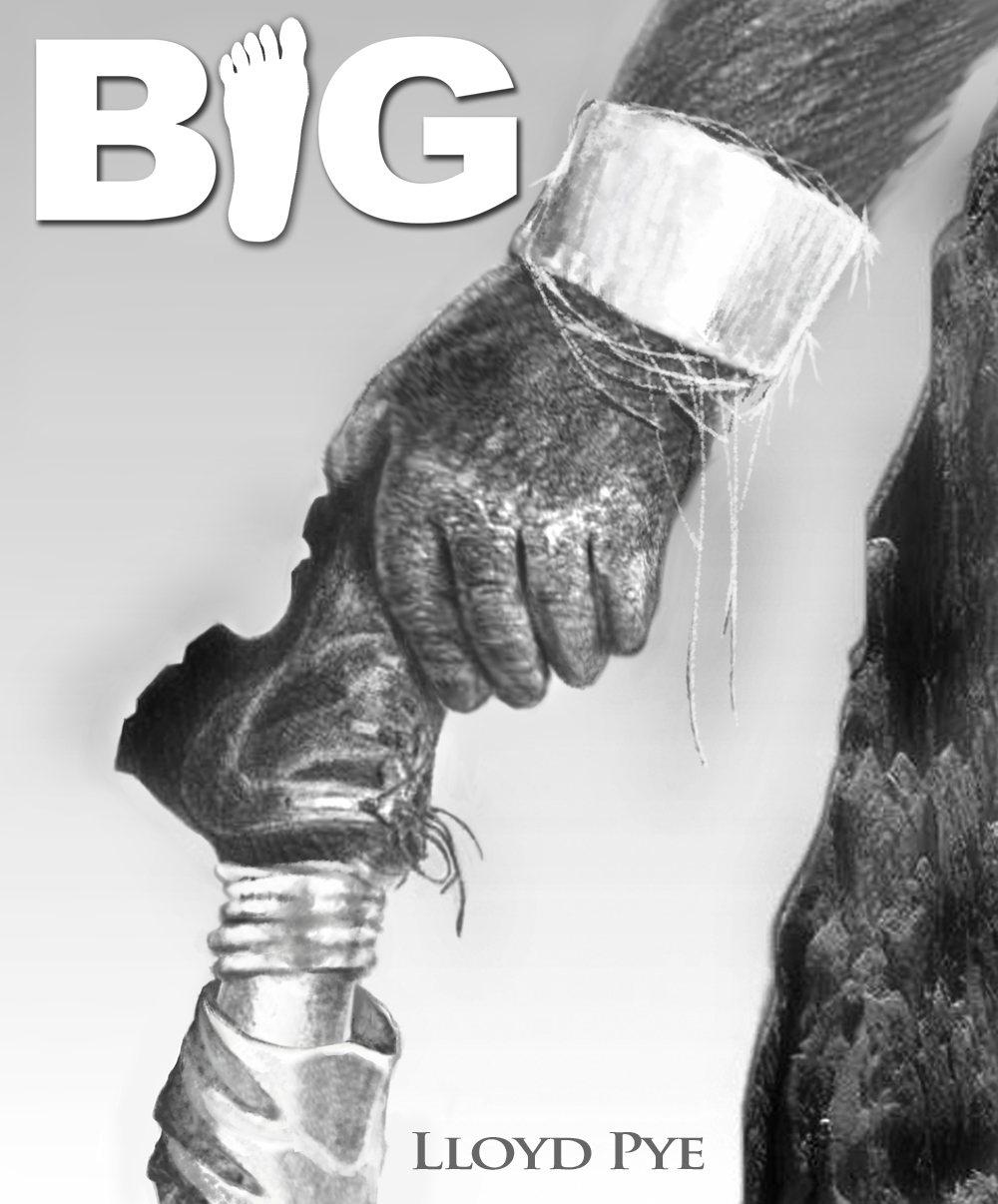
Book Review of Lloyd Pye’s Book, “Big”, by Scott Davis

Book: “Big” by Lloyd Pye

Reviewer: Scott Davis for Oregonbigfoot.com

A quick intro for those of you who don’t know me: I’m Scott Davis, artist with the Oregonbigfoot.com site and moderator for the Oregonbigfoot Members Forum. [Editor’s note: You can view Scott’s artwork at the Oregon Bigfoot art gallery HERE.] I’ve quietly worked behind the scenes with Autumn for a number of years now, helping her with various projects and ideas. I deliberately keep a low profile in the Bigfoot Research community, but this is a rare moment in which Autumn lured me out into the open to write this book review for you.

I was pleased when Autumn asked me to review this book because I’ve admired Lloyd Pye and his work regarding Intervention Theory, the Starchild Skull and Sasquatch for some time now. Complacency in our quest for learning is never a good thing. The most brilliant minds throughout history have repeatedly demonstrated that it’s not being afraid to question the status quo that has resulted in the greatest advancements in knowledge and the results subsequently gained from that. So, whether one agrees or disagrees with Lloyd’s ideas, he will make you think and question many things, and that is good.

I was curious as to what Mr. Pye would attempt to do in his book, “Big”, which was originally brought to life in the format of a screenplay written back in 1984. Would his sasquatch represent some of the more modern ideas and beliefs about them or would it reflect what we thought back in the mid-1980’s? Was he able to write a good plot with believable characters? Would his bigfoot be the protagonist or antagonist… or perhaps neither? And ultimately… would this be yet another typical “rampaging, murderous bigfoot on the loose” story as we’ve already seen depicted ad nauseam in many previous films and literary works? In the end I was very pleased with the answers to all those questions and some others that I had when I started reading the book. :)

The story opens with hunter/poacher Monty Harper, shotgun in hand, and his speckled pointer dog “Duke” having a very poor day in his attempt to poach game birds, so poor in fact that he decides to head back out of the woods. While contemplating his bad luck Monty starts to notice Duke behaving a bit out of the ordinary. Monty senses that something just isn’t quite right but he can’t seem to figure out what is causing the dog to behave so erratically.

Unable to determine exactly what the problem is, they continue onward until Monty’s truck is finally in view about 30 yards from the road’s open circular clearing. Then, Duke suddenly freezes again, this time his hackle fur lifting and his teeth bared and snarling. Being that Duke is a pointer and well trained to remain silent while stalking, this sudden aggressive behavior really alarms Monty.

Now expecting the threat of a bear, Monty quietly reaches for and loads his buckshot and slowly advances toward his truck. As he swings to the right but sees only trees… until one of the tree trunks suddenly moves and Monty finds himself facing an 8 foot tall male sasquatch. Monty is panic-stricken as the creature studies he and Duke for a moment before casually beginning to walk away. Suddenly seized with equal parts panic, astonishment, and fortune lust, Monty can see only dollar signs in his mind as he quickly takes aim at the bigfoot’s head and fires his upper barrel.

Fortunately for the sasquatch, Monty’s aim isn’t quite true and the heavy pellets strike low and off-center, hitting the shoulder-blade area and tearing out a good sized chunk of hair, flesh, muscle and blood. The sasquatch screams and drops to his knees. Monty quickly aims again and fires his lower barrel but this time he misses badly.

He reloads with his last two buckshot shells and approaches to within 10 feet of the creature, taking a moment to study its features while it kneels in shock, then, again with visions of dollar signs flashing in his mind he aims for the kill shot… but the bigfoot has other ideas.

With a sudden upsweep of it’s arm the Sasquatch grabs the shotgun barrels. Monty reflexively reacts, squeezing his top trigger and firing as the motion causes the gun barrels to misdirect with horrible results. To Monty’s horror, the shot strikes Duke mortally wounding the dog. As Monty cradles his dying pet, the Sasquatch, now in possession of the shotgun, rolls onto his back and cleverly mimicking what it saw Monty do, it points the gun at him and squeezes the trigger. Fortunately for Monty the gun doesn’t fire.

Realizing that this weapon will not work for him the bigfoot stares confusedly at the weapon for a moment allowing Monty a chance to rise to his feet. The sasquatch, now realizing Monty’s attempted escape, takes the gun in both hands and in a display of brute strength tears it in half at the hinge-point as Monty begins a desperate sprint for his truck. He makes it, quickly starts the truck and prepares to flee only to see the bigfoot seemingly appear from nowhere to leap onto the truck’s hood.

After a violent and dramatic chase scene, Monty finally manages to get away from his gigantic, hirsute pursuer, but… the bigfoot is watching where he is going as he departs. The Bigfoot knows that humans live in the tiny community down that the bottom of the mountain and he begins a deliberate and methodical search to exact revenge upon his would-be killer.

And… so begins this fast-paced, exciting adventure that pits man against sasquatch and examines the complex morality and other issues that arise from someone attempting to shoot one of them for profit (which is coincidentally rather ironic, given that such an event has purportedly actually transpired within the last year or so).

As the story progresses, the sasquatch eventually finds and exacts a fair measure of revenge upon Monty (and two of his friends) then retreats to the forest with the intent of making his way back to the other side of the mountain where his own kind find safe haven, but along the way his wounds and the exhaustion from hunting down his attacker take a toll and he passes out in the woods near a pond.

Enter our protagonist, Marcy Dillon, a young lady torn between marrying into a potentially good and prosperous relationship with her long time beau, Paul Granger, or defying local tradition (and Paul’s wishes) by heading off to college to begin her dreams of becoming a doctor. Marcy has come out to the area near Bear Creek Pond in search of various healing herbs at the behest of her friend and mentor, local elder, “Granny Elk”. Marcy needs to learn about the herbs for a report she’s writing and Granny Elk is the local expert on such things as well as being a strong sounding board for Marcy’s personal troubles.

As Marcy begins to wade across the shallow pond she suddenly sees an animal stretched out unconscious under the local legendary tree known as The Last Oak. At first she fears it’s a bear, but then she quickly realizes it is actually a bigfoot… and although she doesn’t know it yet, the very same bigfoot from the aforementioned violent encounter with Monty Harper.

Even though she’s very afraid, Marcy finds the thought of seeing the Bigfoot too compelling to resist so she quietly creeps closer, close enough to get a look at the wound on the creature’s shoulder and realize he’s been shot which immediately causes her sympathetic nature to kick in.

At that moment the creature’s eyes snap open and he roars and tries to move, but he is too weak from injury and blood loss to help himself. He subsequently collapses onto his chest, helpless to defend himself or even flee from this comparably diminutive young lady standing before him.

At this point Marcy’s natural instincts to provide healing rise to the fore and she attempts to communicate and help the sasquatch. It takes some time, but she finally gets him to trust her enough to let her touch him and eventually even treat his wounds. She treks back to her vehicle to get some food and drinks she left there and she brings them to the bigfoot and feeds him. She then leaves, intending to get more supplies and return later to further help her new “patient”.

After returning home, Marcy learns of the bigfoot’s attack upon Monty Harper & his friends. She is the only one who realizes that the creature’s attack was clearly provoked. To her horror she also learns that her dad and her boyfriend are joining Sheriff Sam Powers and his “posse” in their attempt to hunt the sasquatch down. Like Monty, they are driven by the dollar signs they see dangling before them at the thought of capturing or killing a bigfoot. Knowing what really caused the creature to attack, Marcy angrily disagrees with their hunt, but she must watch her words lest she give away the fact that she knows where the bigfoot is.

The story moves along with Marcy’s continued attempts to treat and nourish the sasquatch, whom she now affectionately begins to simply refer to as “Big”, all the while aware that her time is limited. She must get Big nursed back to good enough health to make his trek back over the mountain to the safety of his own kind before the sheriff and his boys show up and track them down. As the posse eventually starts to zero in on their target, Marcy ultimately takes matters into her own hands and heads up the mountain with Big, determined to help him make it home before he can be caught. The rest of this story details those efforts by the courageous young lady as she risks her life to save her new friend and he in turn does the same for her. The book is a pleasant, fast-paced read that moves along briskly from scene to scene, never allowing the reader to tire or get bored with any particular part. Being that it was derived from a screenplay really helps the story as it plays out very much like a movie, easily enabling the reader to envision the characters, scenes and events in their mind as they read it. The characters and dialogue are well written and very believable. Some science eventually gets introduced in the form of Dr. Ann Frazier, a professor of anthropology who has been studying sasquatch for some time, and it is through her dialogue that Lloyd is able to cleverly, and subtly add a brief touch of Intervention Theory into the discussion contained within.

The most interesting character of the story though is obviously “Big” himself, and this is where Lloyd shines in this prose. He gets inside Big’s head… gives us a glimpse as to what thoughts are going through the big fellow’s mind as he encounters each event and person throughout the story. Lloyd does this very effectively, and it really adds a great dimension to the narrative.

Big proves himself to be quite intelligent despite his verbal communication gaps with Marcy. He displays a complex thought process, capable of reason and reaction, capable of looking at a situation, analyzing what course of action to take and understanding the potential ramifications that those actions could bring. Big isn’t just a big monkey… he’s much closer to us in terms of his cognitive abilities.

Therein, I think, lays the crux of whether the reader will enjoy this book or not. If you think that bigfoot is nothing more than an oversized upright bi-pedal ape/monkey… then unless you can temporarily set aside your doubts about Big’s mental prowess, the book likely won’t appeal to you as much as it will others. But… if you are one who is inclined to entertain the speculation that sasquatch is possibly something more than a big monkey, perhaps falling somewhere into the human category, then this story will probably appeal to you very much.

I really liked “Big”. It’s a very good, fast-moving story that’s a fun read which I think can be enjoyed by the bigfoot research community and/or public in general. I’d like to see Lloyd pursue this as a screenplay again now, I think it would make a good film.

– Scott Davis, February 2012

[Editor’s note – Thank you, Scott, for all that you do for us within the OB community and for this well-written review! Lloyd’s book, Big, is available in e-book format here. Also, check out this book, Everything You Know is Wrong. For the last several years, this has been my number one most-recommended book to friends. ;)]


New bigfoot photo?

Melissa Hovey has posted a purported photo of a bigfoot this morning – one that she’s had in her files for several years.

You can read the full backstory here and view the photo here:

http://txsasquatch.blogspot.com/

While I have no comments on the photo itself  (Real? Hoax? There is no way to know, which is why photos are useless as “proof” of anything, the least of which their own veracity), it may be an interesting story for you to follow.

I am grateful to Melissa for sharing the photo, but I won’t be posting it here due to copyright concerns because she stated that the witness expressly requested that the photo not be published in the original correspondence with him/her and permission does not appear to have been obtained prior to publishing. I have photos, similarly sent to me by witnesses, that I have never published because I was asked not to do so – including obviously hoaxed photos. While it frustrated me not to be able to share them, aside from the ethical consideration of doing so when asked not to, there are valid copyright issues at play.

Copyright law seems to be very poorly understood, especially when it comes to the internet. Despite the fact that the internet has become a “free-for-all” where people rarely honor copyright, the photographer, or “creator” in the case of a hoaxed photo, always holds the copyright to a photograph – ALWAYS – and has legal recourse for a copyright infringement tort if they wish to pursue it. Unless, of course, the copyright of that photo has been officially transferred or undeniable permission for use has been given to the person publishing it. Filing or claiming copyright on a photograph does not create a copyright if a previous one exists (due to the photographer having been the one to take the photo, which supersedes any other copyright claim) and one opens oneself up to legal repercussions if the actual copyright holder wishes to come forward and make known that they are the creator of the photo in publicly available court documents.

I see a potential trap here for bigfoot bloggers… A witness provides, privately, a photograph. The blogger publishes the photograph without permission. The photographer (or even creator of a hoaxed photo) subsequently takes the blogger to court for damages. A set-up, to be sure, but the photographer would still be within their legal rights to pursue damages.

That is, of course, if the blogger is financially worth suing, if damages can be proven AND the offended party has the resources to bring suit. Court fees in civil cases can run $10k – $15k for the retainer alone and NO civil cases that I know of – except those against large, insured companies or very wealthy individuals – are taken on a contingency basis. Anyone telling you they will sue you civilly using a lawyer who works on “contingency” is likely full of it and you’re fairly safe to chuckle heartily. Legal threats are free… lawsuits are very, very expensive.

I’m not sure why I got off on a law tangent this morning… the copyright question made me think of it, I suppose. Anyway, I hope this provides food for thought and feel free to leave your comments below regarding the photo in question. Please keep in mind that OregonBigfoot.com does not provide legal advice and we will always keep photos, audio and video shared with us confidential unless written permission has been obtained to share it.


New bigfoot novel & members’ update

Lloyd Pye is a man I consider a friend. His book, “Everything You Know is Wrong” is, by far, the book I have recommended most often to friends. It’s a fascinating alternative look at science, history as we think we know it… and Sasquatch.

Lloyd has written a new fictional book titled, “Big”.

Here’s a brief description of the novel:

“A bigfoot is wounded by a shotgun blast. It exacts revenge, then tries to escape. It loses too much blood and collapses in deep woods, where it is found by high school senior Marcy Dillon. Marcy befriends it and decides to help it elude a posse gathered to capture or kill it. What results is a pulse-pounding, white-knuckle chase onto a deadly mountain, where both their lives hang in the balance.”

The book is available in ebook format here.

Also, the OB members’ media archives have been updated. See my latest photo/video journal entry documenting a historic track find in Lane County. Many thanks to Cliff and Toby for the heads up on these!


Boy in China with “Cat’s Eyes”?

There have been reports floating around the internet lately about a boy in China with “cat’s eyes”. Granted, Nong has beautiful blue eyes, which is a rare sight in Asians. But is the novelty of his eye-color responsible for the claims that his eyes glow when a flashlight is shined in them and his supposed ability to see clearly in the dark, or is there really something special about Nong’s eyes aside from the color?

It is unlikely that a human could “mutate” quickly enough in a single generation to produce a tapetum lucidum – the “bright tapestry” at the back of nocturnal creatures’ eyes responsible for eyeshine. Amusingly, youtube videos are popping up now claiming that Nong is an alien-human hybrid, or “starchild”.

Ongoing encounters at The Campground

It began with a sighting by Oregon Bigfoot member Bill in 1971. Along with Bill, members Nancy and Gary have returned each year since 2007 and have provided detailed field reports of their experiences there, including photos and audio files. The members’ media archives have been now updated with part 37 in an ongoing saga in which Bill and Gary returned to “The Campground” once again in the fall of 2011.

“Habituations”, or multiple, ongoing encounters with Sasquatch by long-term witnesses do not always occur at the witness’ homestead. Often, witnesses will find a particular patch of woods that tends to be frequented by our barefoot friends and encounter them repeatedly there. Two other remote habituation cases immediately come to mind – the Sierra Camp, at which Ron Morehead, Alan Berry and the Johnson brothers encountered Sasquatches repeatedly in the early 1970s (the sound files from those encounters are available at Ron Morehead’s site, BigfootSounds.com) and the case of the Fitzgerald’s, a family who claimed to have repeatedly encountered Bigfoot at a remote lake in the Oregon Cascades in 1974. The Fitzgerald’s story is available in the book Bigfoot All Over The Country by Marian T. Place . This account has always been of particular interest to me because I’ve spent many summer nights at this lake and encountered some odd things there.


Question from a reader to long-term witnesses

Question: For those of you that are involved in a “long term” witness situation and have had repeat encounters with this wondrous being; how, may I ask, were you able to contain yourselves in this creatures presence the first time you came face to face with him/her?

I’m a pretty restrained guy, can run fast, and am pretty brave. However, I don’t know what I would do in a situation where I was put in your place.

Witness accounts have varied in saying that Sasquatch can react to a face to face encounter in many different ways. Hostile being one of them. How did you maintain your composure and keep from wetting your pants in that situation? How did you convey a peaceful aura to this creature to keep them from reacting in a hostile or violent manner?

I have no doubt this creature is, by nature, really a gentle soul. But, even the most gentle of souls can react otherwise in the face of the unknown.

Were you frightened?
Did you just accept fate and pray that the outcome would see you safely back home?
Did you even worry about a bad reaction?

My curiosity is killing a herd of cats here.

Please, do tell???

Dennis P. (a true believer)
Fairview, NJ
January 20, 2012

*****************

Dennis – Thank you for your question. Inquiries such as this, when worded respectfully as yours was, are a positive way to open a dialogue about the nature of Sasquatch and to encourage witnesses to share valuable personal experience. While I cannot guarantee that the long-term witnesses I work with and those who read this blog will answer, I thought your question was important to post.

If you are a long-term witness and would like to provide an answer to Dennis’ question based upon your own experience, please do so below. Thanks! :)

Intellect vs. emotion

This, I believe, is truly what is at the heart of the gulf between witnesses and researchers. Each side is speaking from the only place they know… but they are speaking very different languages.

Those who have not had personal, up-close experiences with Sasquatch languish in ivory towers expounding intellectually upon things with which they have little or no direct experience. Long-term witnesses express frustration when they interact with these folks who would presume to “know” that witnesses cannot possibly be experiencing that which they claim and ridicule them for it. Witnesses experience fear and anger when those who have never stood face-to-face with a Sasquatch soliloquize about the “necessity” for study, a body, a specimen. From the researcher/scientists perspective, it is not at all an emotional issue. But to the witness, who has come to know this proposed “specimen” as an INDIVIDUAL, who has often had life-altering experiences, who has been affected at their core from their interaction with this individual, it is impossible to separate emotion from the subject because they feel EMPATHY.The witnesses react emotionally and they are ridiculed for that as well. For their lack of “objectivity”.

Ironically, it seems that witness are successful because they feel empathy. I have learned, time and time again from my own experiences and from those of other witnesses, that the key ingredient to an increasingly close interaction with the Sasquatch is the willingness to allow them to remain in control of the situation. This requires empathy on our part. We must stand there in the dark, knowing that we’re facing something that could easily kill us with a single swipe of its powerful hand, yet remain passive, with the understanding that the individual who is standing before us requires us to do so in order to gain their trust. In order to gain trust, you must be trustworthy. If we are successful in providing them with the comfort of control, we are often rewarded with increased MUTUAL interaction.

I have a certificate in Early Childhood Education. In college, I learned that the ability to feel empathy is something that is developed in early childhood. Very young children are naturally self-absorbed; It’s all about me-me-me-me. They begin to learn that other people have feelings, needs, wants and desires too, but it is a slow process. As I sit here writing this blog, my beautiful 5 year-old little girl sits on my bed, watching her morning preschool program. During the commercial breaks, she begins jabbering at me about something she’s thought of. I listen, and answer her. And then I say, “Honey, Mom is doing her work. I’ll be done in a little while, but if you want to be in here, you need to be quiet, remember?”  She says, “OK, Mom.” And, as soon as the next commercial break comes, she starts talking to me again. I chuckle. You can only be patient with a 5 year-old. They are still developing the ability to feel empathy for others – to acknowledge and remember that others’ feelings and needs are important, too.

Last night, after we’d gotten home from a long, exhausting day in town, I settled down on the couch for a bit and fell asleep… and woke to a crashing sound in the kitchen. “I’m sorry I woke you, Mom,” Rowan said. “I was cleaning up so you could rest.” I had tears in my eyes. My girl is learning empathy.

Rowan tidying the kitchen

A researcher says to a witness, “I don’t care if you want to protect Sasquatch. I want to prove that they exist. If you claim all these interactions and can supposedly gather that proof, why won’t you? Why should I believe you if you don’t?” The researcher simply cannot fathom having the ability to PROVE the existence of Sasquatch and not doing so.

The researcher cannot empathize with the fact that the witness is empathizing with the Sasquatch.

The witness explains. “I don’t care about proof. I KNOW they exist. I see them often. I just wanted to try to share with you what I’ve learned about them, because I care about them and I don’t like the fact that you’re running around trying to shoot one/film them/exploit them. I understand that you haven’t interacted with one personally. But I hope that if I can make you understand what they’re like, that they deserve our respect, you’ll leave them alone, or at least learn to interact with them mutually.”

The researcher responds. “Where’s your pictures? Where’s your proof? I don’t believe you.” He turns to the other researchers. “Hey, look at this guy! He claims to be interacting with a Sasquatch but provides no proof. ”

The bullying and ridicule begin.

Sometimes it’s overt. Sometimes it is disguised as unemotional, intellectual discourse that disintegrates into nit-picking, semantic argument intended to inflame, embarrass or manipulate the witness into “putting up or shutting up”. In either case, it lacks empathy.

Meanwhile, the witness recognizes and feels deeply frustrated over the irony that the reason the researcher has had little luck in the field is that very lack of empathy. If the researcher could, for just a little while, put away their desire to be intellectually impressive, semantically “correct” and in control (in other words, wanting to be RIGHT based on little or no actual personal knowledge), they might actually approach the subject in a way that would benefit them with meaningful interaction that might answer some of their questions. It won’t provide them with an opportunity for proof, though. That would require the researcher being in control of the interaction with the Sasquatch, which is counterproductive to interaction. But the researcher WANTS proof. So they try to remain in control. Round and round it goes, leaving researchers chasing their tails for the last 50 years.

My dad has a saying… “Would you rather be right, or would you rather be happy?” It’s not just good advice in marriage… it’s pertinent to bigfoot research, too. ;)

See, the witness knows something the researcher doesn’t; not the other way around. The witness has first-hand knowledge that the researcher wants desperately. But the witness recognizes that they’re fighting a losing battle trying to communicate something that the researcher DOES NOT WANT TO HEAR because it won’t answer the question that the researcher is asking (IF they are, not WHAT they are), so the witness clams up and slips back into obscurity. It’s no skin off their nose. They still don’t need proof because they’re still having their experiences and they don’t feel the need to prove it to anyone else. Ticked off at a researcher’s arrogance and lack of empathy, witnesses will sometimes smugly get off that parting shot, reminding the researcher that because they are a witness they don’t need proof, which then REALLY frustrates the researcher because his fear is that the witness really did have the ability to produce the goods and simply wouldn’t produce them…. for reasons the researcher STILL cannot fathom. Again, for lack of empathy. The researcher is pissed because he couldn’t manipulate the witness… in other words, couldn’t CONTROL him.

And in the midst of our getting caught up in differences of perspective between humans, we forget the most important thing of all: Sasquatches don’t give a flying rat’s patootie whether you’re educated, intellectually superior or really good at arguing semantics. They don’t care that you want proof of their existence. They only care whether you’re a control freak or not. They only care about your ability to empathize with them and interact accordingly. It’s how they survive in spite of us.


Local Residents Spot Bigfoot In West Virginia… and 2012

Happy Holidays!

A recent sighting report in an article written, for a change, factually and not in a tongue-in-cheek manner. Bless those in the media who write news as news and not as sensationalistic commentary.

Local Residents Spot Bigfoot In West Virginia

The following is unrelated to bigfoot… I think… but it’s another interest of mine so I thought I’d share. I’ve been reading quite a bit about 2012 lately. ‘Tis the season, after all.

This webpage from NASA is interesting. It discusses the science behind the internet sensationalism surrounding December 21, 2012 that has been increasing in the past few years.

One bit in particular caught my eye:

It’s almost a sidelight that the winter-solstice sun will never actually “eclipse” the galaxy’s true center, the pointlike radio source marking the Milky Way’s central black hole. Moreover, the winter-solstice sun won’t even pass closest to it on the sky for another 200 years. What did the Maya themselves think about End Times? There is no evidence that they saw the calendar and a world age ending in either transcendence or catastrophe on December 21, 2012. Some Maya Long Count texts refer to dates many baktuns past 13 and even into the next pictun and beyond. For instance, an inscription commissioned in the 7th century A.D. by King Pacal of Palenque predicts that an anniversary of his accession would be commemorated on Oct. 15, 4772.

In all of the Long Count texts discovered, transcribed, and translated, only one mentions the key date in 2012: Monument 6 at Tortuguero, a Maya site in the Mexican state of Tabasco. The text is damaged, but what remains does not imply the end of time.

That got me wondering… What is Monument 6? I looked it up on Wikipedia…

Tortuguero (or El Tortuguero) is an archaeological site in southernmost Tabasco, Mexico which supported a Maya city during the Classic period. The site is noteworthy for its use of the B’aakal emblem glyph also found as the primary title at Palenque. The site has been heavily damaged by looting and modern development; in the 1960s, a cement factory was built directly on top of the site.

Most of the surviving monuments of Tortuguero come from the reign of B’alam Ajaw (“Jaguar Lord”) who ruled from 644 to 679. These record several victories over nearby states and may indicate that both his father and son were named Ik’ Muuy Muwahn.

Monument 6 from Tortuguero is currently generating discussion as it includes the only known inscription depicting the end of the current 13-Bak’tun era in 2012. Grube, Martin and Zender have stated it refers to “the end of the 13th b’ahktun which we will see in the year 2012” and as to what will happen, they say, “…utom, “it will happen”  followed by something that we cannot read  and he “will descend” yem. The last glyph begins with ta followed by something. However, this is not the end of the world.”

This happy interpretation is supported by Markus Eberl and Christian Prager. They identify the fragmentary word translated above as “descent” seems to be the same one used during building dedications. They also point to a panel on Temple XIV at Palenque, which shows that a positive event took place on July 29, 931,449 BCE involving a vision serpent named Sak Baak Na’ Chapat and his deity K’awiil, which was overseen by B’olon Yokte’ K’uh.

Gillespie and Joyceand also Houston and Stuart have concurred that the inscription on Monument 6 concerns the god(s) Bolon Yokte’ K’uh – specifically “…a calendrical event in the early 21st century AD, at which time, apparently, the god may ‘descend’.” Stuart has recently given a more complete translation: “”The Thirteenth Bak’tun” will be finished (on) Four Ahaw, the Third of K’ank’in. ? will occur. (It will be) the descent(?) of the Nine Support (?) God(s) to the ?.” Gronemeyer gives an epigraphic analysis and calendrical reconstruction of Monument 6 in his Master’s thesis, with illustrations. It has been indicated that ‘Bolon Yokte’ K’Uh’ could refer to the 9 Lords of the Night who featured in both Aztec and Mayan calendars yet remained unnamed in the latter, as the Nine Lords of the Underworld were known as ‘Bolon ti ku’.

Most recently, Gronemeyer and MacLeod have scrutinized Monument 6 again and offer a new interpretation of the passage dealing with the 13-Bak’tun ending. According to them, the inscription announces the witnessing of the deity Bolon Yokte’ K’uh who will be publicly displayed by the occasion of his investiture. By applying several linguistic and ethnographic parallels, this may happen by the enrobing and/or parading of an effigy of the said deity.


Sometimes, when I read passages like this full of unfamiliar terms, my brain checks out and I feel like I’m listening to the Peanuts parents talk. “Wah-WAH-wah-WAH-wah-wah…” Much to the consternation of the guys in my life, listening to discussions about sports has always the same effect on me. But I digress.

My interpretation of this, in layperson’s terms, is as follows:

Here’s Tabasco.

Here’s Monument 6:

Here’s the translation:

“On December 21, 2012, the 13th Baktun will be terminated. It will happen. Darkness. It will be the descent of the Nine Support Gods to the…” According to the Maya, someone is coming or something is going to happen. Or something like that. Whatever it is, I’m not sure I like the sound of it.

See the lower right side of the tablet? The part that tells us exactly what’s going to happen? It’s gone. GONE. Apparently, we humans built a cement factory on top of these ancient artifacts – which were written in stone, mind you, in order to ensure their survival – and we obliterated the Cosmic punchline in the process.

Does anyone else see the irony here?